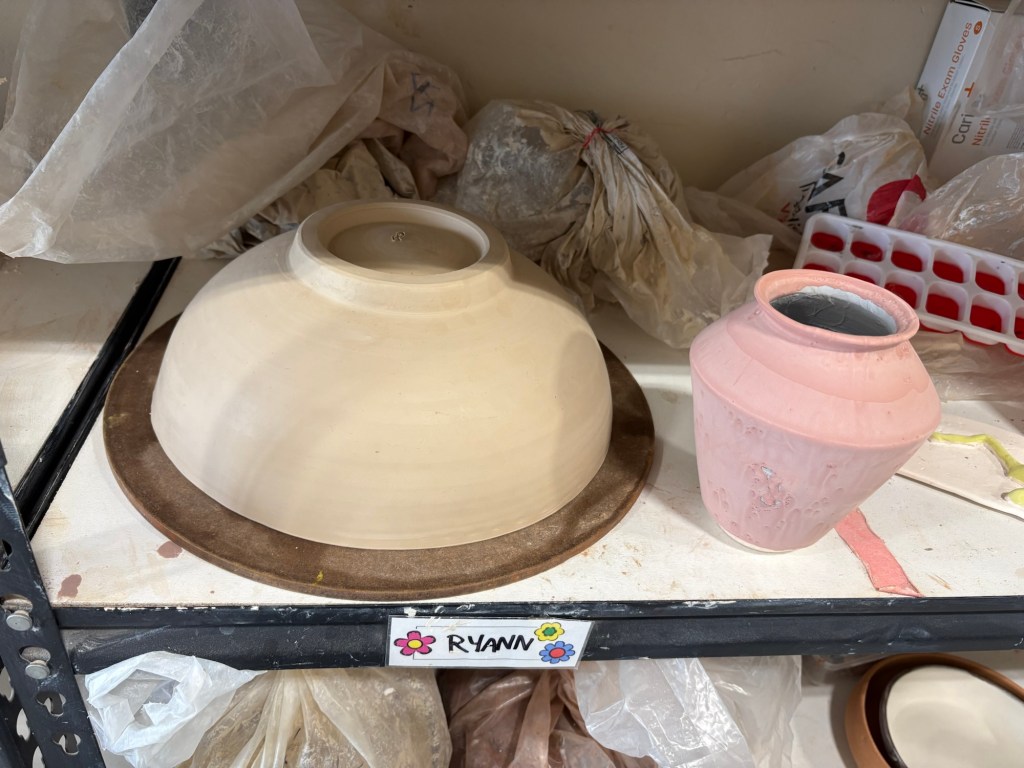
When I arrive at the clay studio where I have recently become a member, I always gravitate toward one particular wheel: in a corner, where I can sit with my back against the wall, like a mob boss. I suppose it makes me anxious to imagine other potters looking over my shoulder at the messy, misshapen artifacts that make up the majority of my output. But my intention is not to be antisocial; in fact, I am so starved for adult human interaction that I often find myself butting in on the eavesdropped conversations of other potters. In this way, I have learned that the studio manager, a woman named Emily—the only person I’ve ever met who uses her eyelids as a palette for elaborate, nail-art-like designs—is a Type 1 diabetic who wasn’t diagnosed until adulthood. And that a fellow classmate, a woman named Artemis, has been practicing sobriety and exploring polyamory.
These days, in fact, the studio is my primary entry point into the world outside my home, a site that is principally organized around the needs of my two small children. The studio has provided me with my only tangible sense of community since my spouse and I left Brooklyn, my home of nearly eleven years, and moved to Oakland in June of 2019. At the time, I was six months pregnant and facing a year that, unbeknownst to me, would be among the most isolating of my life (as it was for almost everyone, I suppose). It wasn’t until I began taking ceramics classes in 2023, six months after the birth of my second child, that I regularly began interacting with adults to whom I was not either: a) married, or b) paying for child care.
“What are you working on today?” This is how most organic conversations in the studio begin. Often I don’t have a particular destination—I’m just slamming hunks of clay onto the wheel and seeing where they end up—but the other members tend to be more purposeful. One, a man named Drew, used to be an architect in New York—where we were briefly neighbors—but now makes his money playing the stock market. He grew up in Kentucky and wears workmen’s overalls over his large frame, his long hair tied back and his face hidden behind a big bushy beard. His smooth, angular pots are almost maddeningly well-proportioned. I try to copy them but can never quite get mine to come out right.
Most of these studio acquaintances are merely that, but I have nearly crossed into genuine friendship with a couple of them. At the end of our beginners’ class together, I exchanged numbers with Artemis and with Rebecca, a nurse from New York City who has been unemployed since coming down with long Covid a couple of years ago. At one point I thought of inviting Rebecca to our house for Passover, but our brief conversations about Gaza have made me wary of delving too deep into our divergent attitudes on Judaism.
I started taking classes at a different studio, up in Berkeley, driving along 580 through its dizzying warren of interchanges up to the Gilman Street exit and then, once class was over, hauling ass back through 5 o’clock traffic to pick up my older son from preschool. I enjoyed the process of pushing clay around on the wheel, though I was tremendously bad at generating any recognizable ceramic form, but what I most remember from that time is the quotidian anxiety of the California traffic jam.
After the Berkeley class, my interest unquenched, I knew I would need to find a studio closer to home. At Merritt Ceramics, close to the eponymous lake at Oakland’s center, I took two more six-week beginners’ courses, and very, very gradually, I began learning to exert dominance over the clay, rather than the other way around. But it has been far from a linear process.
***
Unlike the textile crafts I had taken up as a child—knitting, crocheting, quilting—throwing clay on a wheel does not come naturally to me. Even now, nearly three years later, I’m simply not very good at centering more than a pound or two of clay on a wheel, to say nothing of pulling or shaping it. Some days I still cannot seem to find a comfortable way to sit, cannot get my arm hooked into my side like I’m supposed to, and despite all my efforts, the clay violently throws itself from side to side against my palms until it is too sloppy to shape at all.
For a long time I was convinced that the key to my problem lay in my proportions. If I could only find the right combination of seat height and cant, of shoe-lift bricks and arm placement, surely I could crack this thing. But then I noticed other short people centering without difficulty, and I realized that the issue was probably more internal than external. Presumably it had to do with my general lack of core strength. I diligently resisted seeing in this a metaphor for anything else.
Perhaps it’s because of this general ineptitude that I’ve been able to sustain this practice for so long. In general, I display a dilettantish tendency to abandon any new hobby as soon as I’ve achieved even a basic sense of mastery over it. I may return to it years later, as I did with knitting in my late twenties, after a friend encouraged me to join her in a top-down sweater-knitting class at the back of the Purl SoHo storefront (RIP). My knitting renaissance lasted a few years and resulted in several more sweaters, including a formfitting navy blue cap-sleeve crewneck I gave to my then boyfriend, unaware of an ancient superstition that doing so would doom our relationship. No matter; we married.
But truthfully, I’ve always loved knitting, and coming back to it, for lack of a better cliché, feels like coming home. As a fidgety, anxious person, I need something to do with my hands, and better it be looping yarn over needles than chewing my fingers to death, to which I am wont to resort in a pinch. It gives me something to do while waiting or watching TV, fulfilling my twitchy brain’s constant need to split attention. And perhaps most important, it provides a calming background meter to my body and thoughts. It temporizes me, like a steady, self-soothing metronome.
In fact, maybe this is what I like most about the textile arts. They produce and are produced by a rhythmic back and forth that generates a tangible music, one that grows in your hands as you play it. In 2016, following the boyfriend sweater, I took up weaving, when said boyfriend gifted me a weekend workshop for my thirty-third birthday. Once again, I fell in love. The class was in Gowanus, at the Textile Arts Center, whose industrially high ceilings and creaky wooden floors somehow lent it a homey, oasis-in-the-urban-wilderness texture. My fellow classmates were women, most around my age. One was wearing a white T-shirt whose block-printed letters read THE FUTURE IS FEMALE—a possibility that seemed surprisingly within reach that October. Apart from our questions, we remained largely silent during the twelve hours we spent in the studio that weekend.
Weaving, I learned, is mostly windup. Setting up a loom is a long and tedious process of measuring yarns and then spooling them out to make a warp. Using a small crochet-like hook, you must pull each individual thread through the holes in the loom’s heddles—thin metallic sticks that move up and down as you depress the pedals, creating a space, called a “shed,” through which to push the other half of woven cloth, the weft. This is a back-straining process that takes hours to complete—and it must be done perfectly in order to create the desired pattern of the finished textile. One mistake and you must undo everything that came after. Finally, using another, larger hook, you pull—or “sley”—each warp end through the tines in the reed, a long comblike bar that sits in front of the heddles and serves to evenly space each thread across the loom.
Once all is set up, however, the process shifts from a practice in fine-motor methodical patience to something more resembling some kind of Slavic folk dance—feet dancing across pedals and arms throwing little wooden sticks wound with weft, every pass of the shuttle punctuated by a pull of the oarlike reed, ending in a percussive beat as it packs each weft thread tight along the loom’s front beam. Weaving in a group is noisy, frenetic, and deeply satisfying.
But nothing is more satisfying than watching a piece of cloth emerge, thread by thread, as the warp directs the weft into predetermined patterns of twill or satin or huck. Seeing your cloth grow is like intercepting a telegraph from space and watching it roll out a message only you can decode.
I was also immediately smitten with the weaving workshop’s instructor, a Portuguese woman named Isa who radiated bohemian charm. After the workshop, as the long and dreary fall of 2016 bled into the dispiriting winter of 2017, I continued taking classes at TAC: in double-weave and warp-painting and natural dyeing. Eventually I began volunteering in exchange for free use of the studio. A couple of years in, I fell so far down the weaving hole that I even bought a loom, a 5′ by 5′ Macomber Type B folding loom that I found on eBay and purchased from a widower in Connecticut who wanted to clear his garage of such bulky reminders of his late wife. We hauled it back to Brooklyn one night in a rented minivan. It now sits three-thousand miles away, in a shed in my backyard.
Yet, in spite of my obsessive diligence, I did not make many friends at the weaving studio. Perhaps it was just the nature of New York City social norms, perhaps the age difference—most of the studio’s instructors and staff were in their twenties, a decade whose preoccupations I found increasingly foreign. Perhaps it was the faux pas I committed one afternoon while volunteering, when I gleefully speculated about the possibility of selling one of my better pieces. Isa, I realized as I watched her face tighten, was too artistically pure to be impressed by the success of commerce.
I did become friendly with one of the other volunteers, a woman named Linh who was more of a seamstress than a weaver. In the spring of 2018, as I began to plan my summer wedding, I became taken with the fanciful idea that I would make my own bridal outfit. I wove myself a huck-lace huipil top, simplistic yet beautiful, and decided to make an accompanying skirt as well, despite not having sewn since making a tote bag in seventh-grade home-ec. While perusing fabrics at Mood, I chatted with a woman who counseled me, a bit condescendingly, not to get out of my depth with the tricky fabrics of the charmeuse/chiffon family. So, out of a lifelong, self-punishing need for silent revenge against strangers, I purchased several yards of a pale silk crêpe de chine and bought a vintage skirt pattern off Etsy.
I was indeed tremendously out of my depth, and fortunately, after weeks of watching me curse my flighty crêpe under my breath as I chased it across the studio’s tables with a fabric-marking pencil, Linh very graciously came to my rescue and offered to fix the most egregious of my errors, namely the zipper.
But I never hung out with Linh, or anyone else from the studio, in the outside world, and as winter descended again at the end of 2018, I found myself consumed by other projects—a book proposal and a baby. By April, I had landed the book deal and revealed the pregnancy. We made plans to move back West, to the Bay Area, where Henry had grown up and, even more crucially, had managed to find a significantly better-paying job working in the tech industry.
***
Interestingly, like textiles, pottery also uses the language of “throwing”—but the reference is fundamentally different. Whereas a weaver must literally “throw” the shuttle carrying the weft from one side of the warp to the other, in ceramics, it is the wheel itself that does the throwing. The potter’s “throw” derives from an Old English word, thrawan, which means “to twist or turn.” As the wheel spins—whether by the kick of a foot or, today, an electric motor—the clay moves with it, waiting to be shaped, or turned, by a potter’s hands.
The difference between these two actions is representative of everything that makes throwing pots and weaving cloth diametrically opposed practices. The heavy acrobatics of weaving are here supplanted by a constant, steady stillness. To center clay, I have been taught, is not merely to press down forcefully with your hands until the clay acquiesces. Because, in fact, it will not. The centripetal power that can constrain the clay into a smooth, even disc must come from deep within—from the potter’s own center. That the lexicon of potting quickly veers into the embarrassing realm of bastardized Eastern mysticism does not make it any less true on a kinesiological level: without a strong core, you simply cannot effectively stabilize yourself against a spinning hunk of clay. If you do not control it, it will control you. As I have learned. Many times.
This, really, is why it puzzles me that I have become so immersed in the art of throwing pots. It is, fundamentally, an activity for which I have no inherent aptitude. I was made for the fiddly, the fine-motor, the twitchy-hand crafts. I have never been athletic or strong, never prone to stargazing or birdwatching, never gifted with an attention that permits itself to be focused on the unyielding.
But maybe I have finally reached a point in my life where the idea of bearing down and burrowing into myself does not induce an immediate existential panic, a dread that I have learned to evade through mechanisms both healthy and not: sleep, activity, alcohol. And, truthfully, I have carried myself quite far on stubbornness alone. Sometimes literally: In the summer of 2003, just before my twentieth birthday, I decided on a lark to train for the Portland Marathon, which I completed, limping and bleeding from my left ankle, four months later. There’s also the time when, at age sixteen, I spent six months living in eastern France, despite a misery so profound that I counted each day like I was tallying up a prison term. Or the time, five years later, that I spent another lonely six months on the opposite side of France, trying to prove to myself that I could not be broken by a mere country. (It broke me.)
Whatever the case, now, as I enter my forties and find myself living out dreams I never dared to have—marriage, parenthood, home ownership—I continue to surprise myself by not giving up on something that still has not ceased to elude me. I may never find my center while sitting at the potters’ wheel, but perhaps I will make some new friends—and even forge a kind of community.
 ryann j. liebenthal