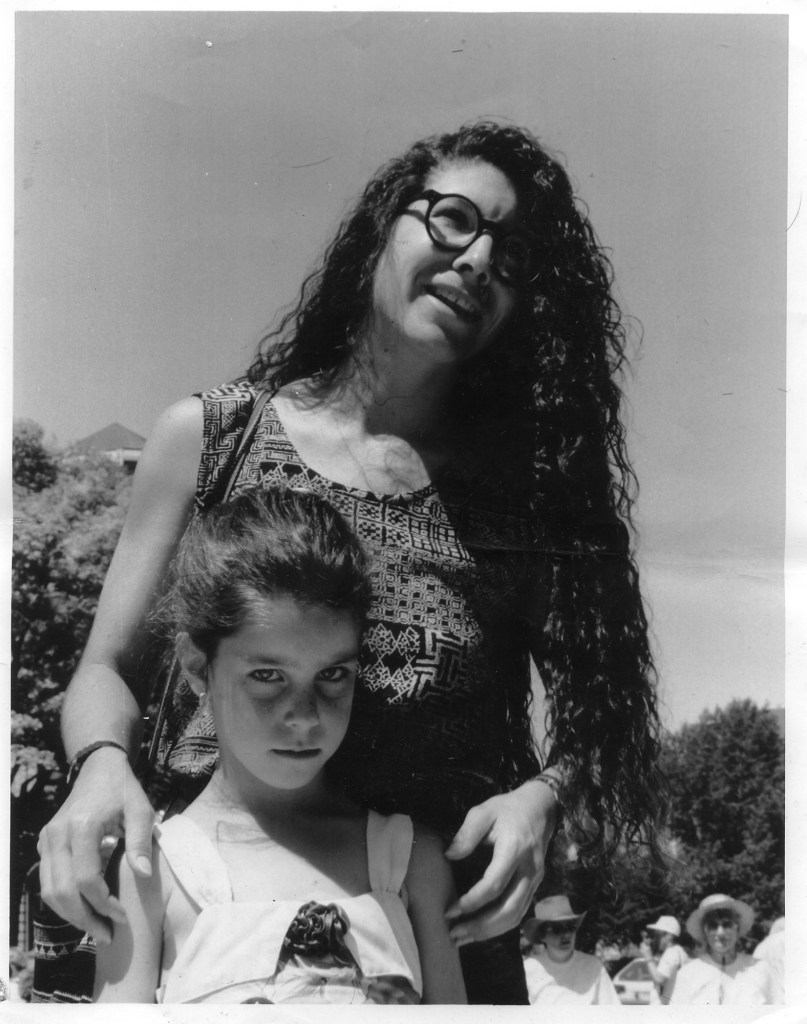
There’s a story I like to tell about how I became Jewish: When my parents met in Yellowstone National Park in their early twenties, my father had appeared to my mother as a long-haired, guitar-playing hippie. When they divorced a half decade or so later, it was in large part because he had revealed himself to be something very different: a Reagan Republican whose conservatism and religiosity had been effectively disguised by a nonchalant approach to personal hygiene and a consistent haze of alcohol. What followed in the months after my birth was a descent into interlocking forms of fantacism—A.A., Christianity, a particularly Western flavor of Horatio Algerism. When my mom persuaded my dad, in a moment of what he later described to me as “weakness,” to pay a visit to the Idaho Department of Health and Welfare, he found a retributive redemption in his inability to throw our family’s lot in with the other sponges seeking handouts from the federal government. In other words, when my parents were so poor that my mom sent him to apply for food stamps, my dad took one look at the people congregated in the lobby and, thinking not of his only child’s welfare but instead of his pride, vowed never to stoop to their level.
If I had been my mother, this would have been the end of it. Only a father—and not a very good one—could look his child’s hunger in the eye and find in it nourishment of his ego. But she was in no position then to leave, and so they stuck it out for another year or two.
Once they finally did split, when I was two or three—old enough to remember, but not old enough to remember when—my dad was free to pursue his new ethic absent any febrile maternal encumbrance. Among other things, he began going to church. I can still conjure the sense of loneliness and boredom I experienced when enclosed in the playpen that served as my sleeping quarters on the weekends I spent at his studio apartment. I also recall the church basements. By day, I would attend Sunday school in their cheerful classrooms, learning of Jesus’ great chestnut-haired beatitude; by night, I wandered these twilit rooms alone, drawing on chalkboards and arranging felt icons as I waited for the meeting upstairs to chime its valedictory Lord’s Prayer.
My mom was on a different trajectory: betrayed by my father’s broken promise to give her the second turn in their college relay, she decided to take the baton by force. Following a fragmented stint in the junior colleges of her native California, where she’d hoped to become a marine biologist, she matriculated at the local university and fell under the sway of its small coterie of radical historians. Steeped in women’s studies, Black and Native and Chicano history, the Howard Zinn of it all, she reacted in horror to the news that I was being indoctrinated in the ethos of “that white, bearded, patriarchal Christian God.”
Rather than try to put a stop to it—she maintained a constant and in retrospect ludicrous paranoia that any aggression might inspire my dad to try to take me away from her—she decided to expand the perimeter until the category of religion collapsed in on itself. In other words, she provided me with a contrapuntally pluralistic religious education: We met with the Quakers, dined with the Hare Krishnas, attended the occasional Rainbow Family mini-gathering, visited the Unitarian Universalists, and, in spite of her entirely secular upbringing, even took a tour of the historic local synagogue. The end result was, I believe, the one my mother intended: religion flattened for me into a befuddlingly open-ended set of arcane practices, none of which held any particular value outside of its relative gastronomic delights (the Unitarians, victors, served donut holes).
There’s an iconic moment in my childhood—one my mom likes to harp on—in which I, all of five or so, was stood on the kitchen table in our duplex apartment. Her college friends gathered in front of me, and I read to them from Emma Goldman’s essays on anarchism. This was a common point of relation between my mother’s friends and me: I was the adorably precocious pigtailed girl accompanying my mom to college classes and punk shows and devouring Little House novels and eschewing cake for carrots. Once, while I waited in my mom’s office at an anti-nuke nonprofit, I asked her boss for paper and markers to draw. Stealthily, I cut and taped printer paper together to create a life-size avatar of myself. On this imaginary me’s T-shirt, I printed the phrase “PEACE, LOVE, AND ABORTION.”
For her part, my mother was a paradox: she was simultaneously strict and loose—she could not stand the chaos I trailed everywhere behind me, but from the time I was able to form sentences, she treated me almost as an equal, a confidante, albeit one she occasionally liked to puppeteer for accolades.
I learned quickly to talk like adults, and about the things adults talked about. At school, no one particularly knew what to do with me—or my mother, who did things like spend parent-teacher conferences questioning why we celebrated the birth of Columbus but not of Martin Luther King Jr. In the third grade, my teacher, Mrs. Jester, scolded me for trying to learn cursive early. On the playground, I remember getting into an argument with a boy named Calvin who told me I was going to hell. We were climbing a set of tractor tires. I must have started off by saying I didn’t believe in God, which was true as far as it went. When Calvin responded, I informed him that hell wasn’t real. When he appealed to the Bible, I replied that “My mom says the Bible was just written by people.”
This approach did not tend to go over very well.
Eventually I got tired of having little kids relegate me to eternal damnation and sensing that adults too were looking at me askance. And that’s when I somehow hit upon my solution:
Instead of telling everyone I was an atheist, I would tell them I was Jewish.
The hectoring evaporated. Children, who hadn’t been briefed on this particular curveball, had no comment; adults, evincing obvious relief at my being something, gleefully informed me that I could count myself among the “chosen people of God,” whatever that meant. It didn’t matter much to me that I really didn’t know what it was to be Jewish; my mom was Jewish and so was I, and that was good enough for me.
*****
I’m not sure when I learned that we were Jewish. It’s one of those bits of information that seemed to have come embedded in my brain from birth. I didn’t know my mom’s family well. The youngest of three, she was closest to her older sister, who lived in the Midwest for most of my childhood. She’d always had a contentious relationship with her brother, thirteen months older, who had tormented her when they were young. He had remained in California, living with his patchwork assemblage of children and stepchildren in a bungalow in Redondo Beach. We visited them once, on a trip back to LA. But after they fulfilled the great California dream of relocating to a stately property on cheaper pastures (in Virginia, in their case), we didn’t see really see them again.
My mom’s dad, Dick, was, to put it mildly, a real piece of work. A short, voluble man who always knew more about everything than everyone else, he had nevertheless failed somehow to figure himself out. He had met my grandmother, Joan, when they were teenagers in Detroit, where the whole clan had started their American journey following some pogrom or another in the nineteenth century. I don’t know much about that Detroit time—what I do know I learned mostly from a single phone conversation I had with my grandfather when I was about 30 and living in Brooklyn. He spent most of it trying to convince me to quit my job and go work for Amy Goodman instead.
At some point the pair moved west, to California, and my grandfather began working as an architect. My grandmother became a high-up official in the city’s HR department—a rarity for a woman in those days. They had a daughter, Robin, in the late 1950s, and then a son, Robert. My grandmother did not want a third, but a year later, my mom arrived. They named her Diana. She changed it to Deanah in adulthood. Once I’d teased her by using her childhood nickname, Dee Dee, and she responded with a ferocity that terrified me. I never did it again.
I don’t know whether my grandparents made a conscious choice to raise their children without religion. My great-grandparents had followed Orthodox customs and spoke Yiddish at home. Their children continued to observe the big occasions, like the High Holidays and Passover. But by the time my mom was a kid, they were also displaying a Christmas tree in their living room each December. There was something about that generation of American Jews—born just before or during the war. It was as though their Jewishness itself was a source of grief to be sublimated, its patterns of behavior and thought and physiognomy traitorous stigmata—an ethnic asterisk that brewed, if not suspicion, then a kind of adjectival banishment from a fully realized national identity. And where better to construct a false edifice of Americana than the smog-shortened backdrop of midcentury Los Angeles, its every peculiarity of accent and custom and feature flattened under the asphalt rollers that broadcast suburban homogeneity from the soundstages down across the sun-soaked Valley. Forget it, Joan…
At some point my grandfather went back to school to become an English teacher, and he spent that part of his career teaching in Watts. He had a commitment, however self-serving, to racial justice. But eventually he and my grandmother divorced, and when my mom was thirteen, he moved up to the Trinity Mountains in northern California, to a tiny town called Hyampom that I remember as sitting at the very tip-top of a huge mountain, like something in a Dr. Seuss book. Up there he worked as a log roller for the Forest Service. He didn’t have a telephone, so my mom, who adored him, wrote him letters. In response, he would send the letters back to her with the grammar corrected.
Hyampom was an edenic place—at the bottom of the hill on which my grandfather’s cabin was perched coursed a small river that eddied into a deep pool bookended by diving rocks. The water was cold and the air was pure. But it was almost impossible to get there. When I was younger, we had visited Grandpa Dick, in the weathered-wood house he had partially built himself, exactly twice. The first time, my sadistic uncle John refused to slow down on the winding road, and I threw up cranberry juice all over his new white car upholstery. My mom and aunt, laughing, told him he’d gotten what he deserved. The second time, I was about fifteen and spent much of the trip lounging in the hammock with my Discman. My grandfather gave a listen to “Miss Misery” and scoffed at the singer, who sounded to him like a “teenage crooner” from the 1950s.
My grandfather was a difficult and confounding person, there’s no way around it. He was opinionated and pigheaded and unapologetic. When he sent me letters or birthday cards (rarely), he always misspelled part or all of my name. Once, he offered to get my mom a music-service subscription for some birthday or other; she said she’d appreciate anything but opera, which she detested. In response, he sent her a box set of Pavarotti CDs. He obsessed over weight—his and others’—and ran marathons into his seventies. I remember him visiting us once when I was about twelve; he took me down to the high school track and tried to fill me with the joy of running—while he watched from the stands. My mom’s tortured relationship with him caused her anguish until the day he died, at 90-something, when I was pregnant with my first son.
Among my mom’s relatives, the most enigmatic and tantalizing was her own mother, Joan, whom I am said to resemble in spirit. Growing up, I used to think maybe I was her reincarnation, or at least that some part of her resided in me, continuing to watch over my mom, who had been a source of great frustration and, I imagine, regret.
When my mom and dad were living together, before I was born, this grandmother, a lifelong smoker, had gotten sick with cancer, and soon she was dying. In the winter of 1983, my aunt Robin called my mom and told her to get herself to LA. On the plane ride down, she worked out a plan to break up with my dad upon her return. By the time she arrived in Los Angeles, it was too late. She had missed her goodbye, and I my hello—on the flight back up to Idaho, my mother felt so nauseous she was sure she was going to throw up. This was alarming for a woman who counts it as a point of almost infuriating pride that she absolutely never throws up.
When I was born several months later, my mom nestled her own mother’s name in the middle of mine. I still feel like it is a piece of her embedded within me.
I have vague memories of Joan’s mother—my great-grandmother Sadye, who outlived her daughter—nothing more than the sense of her as a beneficent, joyful entity. My mom had also remained close with her brother’s sister, Elaine, who still lived in LA and whom I for the longest time knew as “Auntie Lane.” Elaine’s brother David, too, whom everyone inexplicably referred to as Uncle Pork Chop. He lived back in Lansing and spent his retirement years working as a birthday-party clown with his wife, Myrna. But we never saw much of any of these relatives, either. Everyone was so distant and scattered—a diaspora within a diaspora.
My dad’s family was a completely different story.

